Here is the Sneak Peek for the novel A Reckoning of Hearts
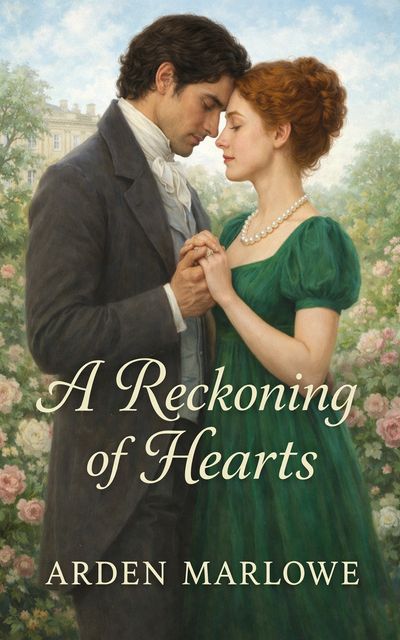
Chapter 1
8 March 1803
Lyle House, Berkeley Square, London
The ballroom was a glittering constellation of candlelight and polished marble, where strings and woodwinds serenaded the spring air heavy with perfume and pride. Every mother angled her daughter toward a coronet. Every bachelor scanned the crowd for a dowry or a dalliance. And every chaperone, armed with a fan and steel-spined propriety, stood sentinel against scandal.
Juliana Margery Soller, Marchioness of Lyle, stood at the edge of the polished floor—tall, luminous, and already the subject of murmured speculation. It was her debut ball, but she did not enter as a girl uncertain of her place. She had inherited a marquessate at sixteen, commanded estates many men envied, and no handbook on feminine modesty would teach her to dim her brilliance now. The Lyle Pearls circled her throat like a legacy, catching fire in the candlelight with every subtle movement. Her gown—deep emerald silk, cut daringly close with a golden sash knotted high beneath her breasts—defied the season’s fashion plates without apology. Her hair, that unmistakable copper flame, was swept into a Grecian knot that glowed like a crown atop her proud, sculpted head.
And then she saw him.
Lord Edward Devereaux, second son of the Duke of Elliston. He was precisely the sort of man no mother wanted near her daughter and one every daughter secretly dreamed of taming. Tall, lithe, golden-haired—he seemed painted by some idle god with too much time and too much pleasure in beauty. His coat was sleek black, his waistcoat ivory, his cravat an artful masterpiece. He leaned against a column as though it offended him, all careless grace and bored detachment.
Juliana’s breath caught.
“Adonis,” she murmured, almost to herself.
At her side, her aunt Maribelle, the dowager Countess of Ashbourne, stiffened. “That, my dear, is Lord Edward Devereaux. He is not Adonis. He is Dionysus in lace cuffs, and you would do well to remember it.”
Juliana smiled, her green eyes still fixed on him. “He is beautiful.”
“He is dangerous. He’s been turned out of half the gaming hells in St James and half the boudoirs of the demimonde.”
“And yet he is here,” Juliana said, “welcomed into polite society.”
Maribelle gave a most inelegant snort. “Polite society has a long history of poor judgment.”
But Juliana had already stepped away, eyes on Lady Dalrymple, whose fondness for her late father would serve nicely tonight. A word, a smile, a perfectly timed compliment—and the introduction was secured.
Lord Edward turned, eyes catching hers as though he'd felt her approach. “Lady Lyle,” he said, bowing over her hand. “Forgive me, but I had not expected Mars in petticoats.”
Juliana arched a copper brow. “And I had not expected poetry from a Devereaux.”
He grinned, teeth like pearls. “Ah, so you’ve heard the rumors.”
“I make it a habit to collect them.”
“Then I hope to add to your collection.”
“Something shocking, no doubt.”
“Only if you’ll allow me the pleasure of proving them true.”
Before her aunt could materialize with a sharp rebuke, the musicians struck the first notes of a country dance. Edward turned smoothly to her and offered his arm. “Shall we scandalize the room together?”
She glanced at her dance card and decided to ignore it entirely. “I cannot think of anything I’d enjoy more,” Juliana said, placing her hand in his.
They took their places opposite one another. The dance began—ordered, elegant, deceptively tame. But each time the pattern brought them together, Edward’s gaze lingered. Once, as they passed one another in the line, his gloved fingers trailed against hers—longer than necessary. At the turn, he whispered something low, meant only for her.
“Tell me, my lady... do you always look at your partners as though you intend to devour them whole?”
Juliana’s lips curved slowly. “Only the ones I find... appetizing.”
His chuckle sent a thrill up her spine.
By the time they reached the final figure, they had spoken little of substance but everything of intent. The touch of his hand beneath hers was firm. Possessive. Slightly too familiar.
“You must allow me another dance this evening,” he said, his voice brushing the shell of her ear.
“Must I?” she replied, her head tilting in mock deliberation.
“Your reputation may not survive it,” he said with a wicked glint.
“I believe it would enjoy the attempt.”
He smiled—lazy, knowing. “Then I am undone.”
As she turned, her eyes sparkled with mischief. “Not yet, Lord Edward. But I’m working on it.”
From across the room, Countess Ashbourne watched through narrowed eyes, her fan snapping open like a warning shot.
Juliana lingered at the edge of the ballroom, pulse still skimming along the high of the dance. And yet, even as she turned toward the crowd again, her gaze shifted—briefly, instinctively—in search of one face. A habit she hadn’t quite managed to break.
But he wasn’t where he should have been—beside the west pillar near the musicians, where he had once stood like a shadow at her father’s side.
A hundred memories stirred. Lucien’s hand steadying her waist when she tripped during a country dance at Caerwyn. The dry curl of his smile when she whispered mimicry of some dowager too shrill by half.
She shook it off.
Her thoughts returned—firmly—to Lord Edward. To his golden charm. To the way the ballroom had seemed to pause when he looked at her.
Lucien Alexander Blackwood, Viscount Hartley, stood near a bank of windows with a glass of champagne untouched in his hand. He commanded the space without effort, wearing stillness like a tailored coat—precise, elegant, and wholly controlled. His features were striking, almost too finely drawn for comfort: an aquiline nose, a full mouth rarely moved by amusement, and a strong jaw made more arresting by the faint cleft at its center. Dark waves framed his face in disobedient contrast to the austerity of his expression. But it was his eyes—pale grey and watchful—that held attention. They gave nothing away and yet seemed to see everything. In that moment, he was both sculpture and storm, all quiet tension and impossible allure.
The scene before him was exactly the sort of thing he had long ago trained himself to tolerate—too many perfumes warring with candle smoke, too many shallow conversations cloaked in silk and satin, and too many bored men eyeing dowries like ripe fruit.
And yet.
Tonight, the air felt charged—alive with something he could not name until he saw her.
Juliana. Ana.
She stepped into the room with a quiet force barely held in check—and entirely out of place, yet somehow the only one who belonged. Her gown clung with subtle defiance to her unapologetic curves, with rebellion stitched in every line, as if daring the room to look away. She was taller than most women, taller than many men, and she held herself with the effortless command of someone who had never once been told she was less. Her hair, pinned with maddening simplicity, drew the eye to the fierce elegance of her face—her father’s bearing, her mother’s mouth, and something untamed that was entirely her own. She was not beautiful in the conventional sense, more statuesque than siren, but he could not look elsewhere. No one could. There was a kind of danger to her—bright, alive, and wholly unaware of just how many hearts she might ruin without ever meaning to.
He felt his chest tighten.
And then she moved—fluid, determined—and in a few strategic steps placed herself squarely before Edward Devereaux.
Lucien’s jaw clenched.
He knew Edward all too well. They had both suffered the brutalities of Eton and the pretensions of Oxford together, though Edward had drifted through them with careless charm and too much money. Lucien had been more selective in his pleasures, more disciplined in his studies, and—if he admitted it—far less inclined to indulgence for indulgence’s sake. They had tolerated one another, clashed more than once, and parted ways with a mutual understanding that civility was preferable to proximity.
But to see Juliana—his Ana, the girl who had once climbed a tree in full riding habit to escape a governess, the girl whose laugh had rung through Caerwyn Castle’s halls like mischief in flight—look at Edward as though he had hung the stars?
Lucien watched, stone-still, as the introduction was made. Edward bowed too low. Juliana smiled too warmly. And then—God help them both—he asked her to dance.
A country dance. Harmless in theory.
But Lucien knew Edward’s talents. He knew the artful flick of his gaze, the calculated touches just beyond what was proper. He had seen too many women misinterpret that practiced attentiveness for affection.
As the music started and they took their places on the floor, Lucien’s hand tightened around his glass.
Juliana was laughing.
Edward leaned in close, murmuring something—Lucien could only imagine—and she flushed, her eyes bright. Their hands met and parted, trailed just long enough to make his stomach twist. Each figure of the dance brought them together again, and each time Juliana looked at Edward as if he were something new. Something… worthy.
Lucien turned away, jaw hard.
A rakehell. A man whose deepest ambitions extended no further than the bottom of a wine bottle or the hem of an actress’s skirt. And yet here she was, beguiled—of course—by his charm, his perfect bloody face, his golden nothingness.
He drained the champagne in one swallow and set the glass aside with more force than necessary.
“Lord Hartley,” came a clipped voice at his side.
Lucien turned. “Lady Ashbourne.”
The dowager countess’s fan snapped open and then shut again. “I see you’ve noticed.”
“I have eyes,” he said coolly.
“She’s made a spectacle of herself.”
“She’s young. She’s curious.”
“She’s a Marchioness,” Maribelle snapped. “And that man is a walking scandal draped in velvet.”
Lucien’s eyes went back to the dance floor. “I know.”
He watched as Edward bowed over Juliana’s hand at the end of the dance. Watched her smile—soft and foolish and full of hope. Watched Edward’s lips move far too close to her ear.
His fingers curled at his sides.
“You should put a stop to it,” Maribelle said, quiet now. “You’re the only one she might listen to.”
Lucien said nothing.
He had no right. Not yet.
But God help Edward Devereaux if he ever touched her heart only to break it.
After their dance, Juliana followed Edward through the open French doors with the sort of reckless delight only an eighteen-year-old heiress could afford. Her slippers scuffing softly against the stone, her gloved hand brushing the sleeve of his coat as they paused at the balustrade.
The night air was cool, sweetened by the heavy scent of hyacinths blooming along the terrace wall. Moonlight spilled silver across the flagstones, softening edges, lending the evening a dreamlike quality—dangerously ripe for illusion.
“You were born to dance, Lady Lyle,” Edward said, turning to face her, his expression dipped in lazy admiration. “It’s a wonder the floor didn’t catch fire under your feet.”
She laughed, low and bright. “Is that how you charm all your partners, my lord? Hyperbole and flattery?”
“Only the ones I want to see again.”
Juliana glanced away, smiling, though her pulse fluttered. The cool breeze lifted tendrils of her hair, and she was suddenly aware of how close they stood—how different this moment felt beneath stars and shadow.
Edward leaned one hand against the balustrade beside her, fencing her in without touching. “You’re unlike any woman I’ve met, Lady Lyle.”
“You’ve met far too many women,” she said, but her voice had gone softer, her wit dulled by the nearness of him.
“And yet none like you.”
His gaze dropped—brazen—to her mouth, then rose slowly back to her eyes. His meaning was unmistakable.
Juliana’s breath caught, but she did not step back. A strange tension hummed between them. It thrilled her.
Edward leaned in, not quite enough to breach propriety, but enough to set every hair along her arms tingling.
“I wonder,” he murmured, “if you would allow me the impertinence of—”
“Ana.”
The voice cut through the moment like the clean edge of a blade.
Juliana startled guiltily and turned. Edward’s mouth flattened as he straightened.
Lucien stood just beyond the shadows of the colonnade, dark and impeccable in a deep green coat that echoed her gown. His expression was pleasant, too pleasant—an aristocrat’s version of a barbed sword in a velvet scabbard.
Juliana blinked, momentarily caught between surprise and relief. “Lucien,” she said, instinctively softening, though she immediately regretted it.
Edward, ever the gentleman in appearance if not intent, offered a mock-bow. “Lord Hartley. How fortuitous.”
Lucien returned it with a nod, his storm-gray eyes cool. “Lord Edward.”
There was a beat of silence, weighted by everything unsaid.
Lucien turned to Juliana. “Forgive the interruption, Ana. Lady Ashbourne was looking for you. Something about your dance card and the Marquess of Denholm’s weak ankles.”
Juliana’s mouth twitched, equal parts amusement and irritation. “I suspect that’s a lie.”
Lucien’s smile was faint and unapologetic. “A plausible one, at least.”
Edward gave a soft huff of laughter. “How very protective you are, Hartley. A guardian’s instincts die hard, do they?”
Lucien’s eyes didn’t leave Juliana’s. “Some instincts are worth keeping.”
Juliana stepped back from the balustrade, adjusting her gloves. “Lord Edward was merely enjoying the evening air with me. I saw no harm in stepping outside.”
“I daresay you didn’t,” Lucien said, voice low and civil.
Edward’s eyes glinted. “Surely the Marchioness doesn’t require a chaperone on her own terrace.”
“Yes, she does,” Lucien countered. “And she deserves better company.”
The words hovered a breath too long in the air. Juliana’s gaze darted between them.
“Gentlemen,” she said crisply, recovering herself. “Shall we all return before my absence is mistaken for scandal?”
Edward offered his arm, but Juliana paused. Her eyes met Lucien’s—and something passed between them: old familiarity laced with a new friction. Without quite knowing why, she placed her hand on his arm instead.
Lucien said nothing, but his posture shifted ever so slightly. He guided her back inside with quiet triumph, leaving Edward behind on the terrace, smiling tightly into the shadows.
They reentered the ballroom in a shimmer of candlelight and music, the hum of conversation rising to greet them like a tide. Though no one openly stared, Juliana could feel eyes flicking toward them—her return on Hartley’s arm had not gone unnoticed.
Lucien steered her not back to the dance floor, but along the perimeter, toward a tall alcove flanked by velvet-draped windows. It was quiet here, half-shielded by a marble pillar and a potted orange tree, far enough from the crowd that words could pass unheard.
“Lucien,” she began, tone already edged, “if this is about Lord Edward, I would remind you—”
“I know exactly what this is about,” he interrupted, low-voiced but firm, turning to face her fully. “And so do you.”
Her green eyes narrowed. “You presume too much.”
“I presume nothing. I’ve known Lord Edward Devereaux since before you were out of leading strings. And I know that whatever charm he drapes himself in, it’s borrowed, and cheap, and likely fraying at the seams.”
Juliana’s mouth tightened.
Lucien stepped closer, just enough that she could smell the remnants of his shaving soap—bergamot, tea, and sandalwood—peppered with the faint trace of tobacco smoke from some unseen corner of the night. “He will flatter you. He will dazzle you. And when he tires of you—when he has what he wants—he will toss you aside like he has every other woman foolish enough to believe in him.”
Her hands balled in the folds of her gown. “That’s a cruel thing to say.”
“It’s a true thing to say.”
Juliana drew herself up, shoulders squared. “You forget yourself, Hartley.”
The use of the title was a slap. Lucien’s jaw twitched.
She went on, voice clipped and cold. “You may be the executor of my estate, but you are not my keeper. I am not your ward, nor your sister, nor your servant. I am the Marchioness of Lyle. I will not be told what to do.” Juliana congratulated herself for managing not to stamp her foot.
“No,” he said, quiet and fierce. “You’ll simply be courted in moonlight by a man with wine on his breath and debts in every club west of Pall Mall.”
Her eyes flashed. “Why should it matter to you?”
That gave him pause.
She pressed on, softer now, angrier because of it. “You dance attendance like some old friend, but the moment I show interest in someone else—someone who finds me beautiful—you appear like a wraith to spoil the moment.”
“I’m trying to protect you.”
“I don’t need your protection, Luke.”
There it was—Luke—spoken with sharp affection and wounded pride.
For a beat, neither of them moved.
Then he said, lower, “Perhaps not. But your father asked me to look after you. I gave him my word.”
“My father has been dead two years. Do you plan to manage me for the next twenty?”
Lucien didn’t answer. He simply held her gaze a moment longer, then offered his arm in silence.
She hesitated, but then placed her hand on it stiffly, and they walked together—quiet, cold—back toward the main floor.
At the edge of the crowd, her aunt materialized like a thundercloud in mourning black, fan already twitching.
Lucien bowed. “Lady Ashbourne.”
“Hartley,” she returned with a nod. “Is all well?”
Juliana answered for them both, all icy poise. “Lucien was just delivering a lecture on my virtue, Aunt. You’ll be pleased to know it remains intact.”
Lucien’s jaw ticked once, but he said nothing.
He bowed again, more stiffly this time, and turned to go.
Juliana watched him retreat into the crowd, tall and dark and unreadable, his deep green coat sharp against the haze of candlelight. Her spine stiffened. She didn’t know what made her more furious—his imperious tone or the fact that she still breathed in the scent he left behind, as familiar as a memory and twice as dangerous.
Aunt Maribelle watched her closely, fan half-raised, the feathers twitching like the wings of a hawk.
“Well then,” she said mildly, “that was rather a tempest in silk breeches.”
Juliana turned toward her. “He is unbearable.”
“He is worried. There's a difference. Subtle—but important.”
“He is arrogant. Interfering. Condescending.”
“Ah,” said Maribelle, tilting her head knowingly. “But just when did you begin staring at his mouth when he scolds you?”
Juliana flushed. “Aunt.”
Maribelle smiled with infuriating calm. “Don’t Aunt me. I’ve seen the way you two circle each other. It’s practically choreography. Though I must say, Lord Edward Devereaux is a rather different tempo.”
Juliana crossed her arms. “Why is it that every time I show the faintest interest in someone, the entire world rushes to warn me off?”
“Because, darling,” Maribelle said, voice lowering as she stepped nearer, “you are a prize too many people want to win—and some for the wrong reasons.”
Juliana’s expression turned flinty. “And you think Lord Edward is one of them.”
“I know he is,” Maribelle said, steel in her whisper. “I’ve seen men like him a hundred times. Beautiful, charming, and as hollow as a cracked mirror.”
“Perhaps I don’t want a man who guards me like a possession,” Juliana snapped, her gaze flicking again to the spot where Lucien had vanished.
“Perhaps,” said Maribelle with soft finality, “you don’t yet know what you want at all.”
They stood in silence, the world spinning around them—jewels, chatter, swirling silk. Juliana’s lips pressed into a thin line. She curtsied stiffly.
“If you’ll excuse me,” she said. “I think I shall fetch a glass of lemonade.”
“Do take care not to spill it into a certain gentleman’s lap,” her aunt murmured as Juliana turned.
But the Marchioness of Lyle was already walking away, head high, shoulders braced, scanning the crowd—not for lemonade.
For Edward.
Lucien moved with calculated grace through the crowd, nodding where required, his expression cool, untouched. Only those who knew him well might have noted the steel in his shoulders, the too-precise cadence of his stride. He needed distance—space to wrestle the storm she’d awakened in him.
Juliana. Ana.
She had looked at Lord Edward Devereaux like he was made of starlight and stolen kisses, not ruined reputations and unpaid debts. And worse—she had called him Hartley. Not Luke. Not Lucien. Hartley.
He rounded the corner toward the card room just as a familiar voice slithered into his path.
“Ah, Hartley. Always a pleasure to see your back retreating from a conversation.”
Lucien turned with slow precision to face James Beauchamp, Earl of Rothford—one of those young bucks of the ton that wore their cynicism like a cravat.
“Rothford,” Lucien said evenly. “I was hoping the floor would open and swallow me before we crossed paths again, but fate disappoints.”
Rothford laughed, unoffended. “Brutal. Your mood suggests someone’s threatened your perfect little world. Not your funds, surely—your cards run too hot for that.”
Lucien’s smile didn’t reach his eyes. “Some of us play with skill. Others with inheritance and luck.”
“And some of us,” Rothford returned, adjusting his cuffs, “chase after unattainable women and gnash our teeth when they prefer prettier company.”
Lucien’s eyes flashed, but his voice remained silk-wrapped steel. “Be very careful, Rothford. You’re not nearly as amusing as you think.”
“Oh, but she is,” Rothford said with a lazy shrug. “I’d chase Lady Lyle too, but I fear I like my pride intact. You, though… you’ve always had a taste for impossible things.”
Lucien stepped close, his smile now a blade. “If you value your teeth, Rothford, best not wrap them around her name again.”
Rothford stilled, but his composure held. He raised a brow, then smirked—with just enough mischief to needle.
“Ah, there it is,” he said lightly. “I was beginning to wonder if there was blood under all that polish. Good to know you’re not as indifferent as you pretend.”
Lucien didn’t answer. His silence was colder than any retort.
Rothford tucked his hands behind his back with an exaggerated sigh. “You may not like me, Hartley, but I daresay I’m not the worst man in this room. And I rather like her.”
Lucien’s jaw flexed.
“Don’t worry,” Rothford added, voice lowering just enough to be heard only by him.
“I’ve no plans to steal what isn’t offered. But if it ever is…”—he let the implication trail, hanging like smoke in the air—“well. That would be a matter between her and me, wouldn’t it?”
Lucien stared at him for a beat. Then, with a single clipped nod, he turned and walked away, every inch of him taut with the effort not to look back.
The card room was dimmer, quieter, heavy with cigar smoke and quiet tension. Men sat in deep leather chairs around green baize tables, dice clattering, fortunes shifting with the flick of a wrist. It was a gentleman’s world, one Lucien understood—predictable, brutal, and devoid of romantic illusion.
He passed the tables without pause, waved off a few offers to join a hand, and made for the sideboard. Pouring a brandy, he didn’t bother with civility. He tossed it back in one swallow, the heat searing his throat, grounding him in the present.
Her scent still lingered on his memory, faint traces of oranges, cypress, and something floral. Her voice, sharp and clear as a bell in frost.
Why should it matter to you?
She’d asked it with wounded pride, but beneath it had been something else. A question neither of them had the courage to name.
Lucien poured another brandy but did not drink it. He stared into the glass as if it held answers.
Because you’re mine, he thought. You always were.
But she wasn’t. Not yet.
And if she let Edward Devereaux charm his way into her affections, she never would be.